Table of Contents
- Introduction
- The Biological Foundation of Collagen
- The Essential Ingredients for Collagen Production
- Types of Collagen Your Body Makes
- What Slows Down Collagen Production?
- How to Support Your Body’s Natural Production
- Collagen and Athletic Recovery
- Why Quality Matters in Collagen Supplements
- Conclusion
- FAQ
Introduction
Collagen is the structural bedrock of your body. It provides the strength and elasticity found in your skin, the resilience in your joints, and the integrity of your connective tissues. Think of it as the internal scaffolding that keeps everything held together while you train, move, and recover. At BUBS Naturals, we believe that understanding the biology behind your body’s performance helps you make better decisions for your long-term wellness.
The process of creating this protein is complex and requires a specific set of raw materials and chemical reactions. Your body does not simply "absorb" the collagen you eat and move it directly to your knee or your face. Instead, it breaks down proteins into their smallest parts and rebuilds them where they are needed most.
This article explains the biological assembly line your body uses to manufacture collagen. We will cover the essential nutrients required for synthesis, the factors that slow down production, and how you can support this vital process through nutrition and lifestyle.
Quick Answer: Your body produces collagen through a process called collagen synthesis, which begins inside your cells by combining amino acids like glycine and proline. This process requires Vitamin C as a critical cofactor to link these amino acids into a "triple helix" structure. Once these strands are formed and stabilized, they are secreted outside the cell to create the strong, fibrous networks that support your skin, bones, and joints.
The Biological Foundation of Collagen
Collagen is the most abundant protein in the human body, making up roughly one-third of its total protein composition. It is not a single substance but a family of proteins that share a unique structure. This structure is often described as a triple helix. Imagine three individual strands of rope tightly coiled around each other to create a single, much stronger cord. This configuration provides the incredible tensile strength required to support your weight and withstand the physical stress of an active lifestyle.
The production of collagen occurs primarily within specialized cells called fibroblasts. These cells are the "construction workers" of your connective tissue. You can find them in your skin, tendons, and other various tissues. Their primary job is to maintain the structural integrity of these areas by constantly producing and repairing the extracellular matrix, which is the network of proteins and molecules that provide support to surrounding cells.
The Stages of Collagen Synthesis
The creation of collagen is a multi-step process that happens both inside and outside the cell. It begins with your DNA. Your genetic code provides the instructions for which amino acids need to be gathered.
Intracellular Production
Inside the fibroblast, the cell gathers specific amino acids—mostly glycine, proline, and hydroxyproline. These are linked together to form long chains called polypeptide chains. During this phase, something called procollagen is formed. Procollagen is the precursor to the final collagen molecule. For this to happen correctly, your body needs a steady supply of Vitamin C. Without it, the chemical reactions required to stabilize these chains cannot occur.
Extracellular Strengthening
Once the procollagen "triple helix" is assembled, the cell secretes it into the extracellular space (the area outside the cell). Here, enzymes snip off the ends of the procollagen molecule. This transforms it into a functional collagen molecule. These individual molecules then group together to form long, thin structures called fibrils. Finally, these fibrils cross-link with one another to form the tough, thick fibers that give your tendons and skin their strength.
The Essential Ingredients for Collagen Production
Your body cannot make collagen out of thin air. It requires a specific "recipe" of nutrients. If any of these ingredients are missing or in short supply, the assembly line slows down, and the quality of the collagen produced may decline.
The Role of Amino Acids
Amino acids are the building blocks of all proteins. While collagen contains many different amino acids, three are particularly important for its structure.
Glycine
Glycine is the smallest amino acid and makes up about one-third of the collagen molecule. Because it is so small, it fits perfectly into the tight spaces of the triple helix. This allows the strands to be packed very closely together, which is what gives collagen its legendary strength.
Proline
Proline is essential for the stability of the helix. Your body uses an enzyme to convert some proline into hydroxyproline. This conversion is what "locks" the strands in place.
Lysine
Lysine helps with the cross-linking of collagen fibers once they are outside the cell. This cross-linking is what allows a tendon to stretch without snapping.
Essential Cofactors: Vitamin C and Minerals
Even if you have all the amino acids in the world, your body cannot finish the job without specific cofactors. A cofactor is a non-protein chemical compound that is required for an enzyme's activity.
-
Vitamin C: This is the most critical cofactor for collagen. It acts as the "glue" that allows the enzymes to attach hydroxyl groups to proline and lysine. Without enough Vitamin C, the collagen fibers become weak and unstable. This is why people with severe Vitamin C deficiencies historically suffered from scurvy, a disease characterized by the literal falling apart of connective tissues.
-
Copper: This mineral activates an enzyme called lysyl oxidase. This enzyme is responsible for the final cross-linking of collagen and elastin fibers, which gives your tissues their elasticity.
-
Zinc: Zinc is required for cell division and protein synthesis. It also plays a role in the "remodeling" phase, where the body breaks down old or damaged collagen to make room for the new.
Key Takeaway: Collagen production is a nutrient-dependent process. Your body requires high concentrations of glycine and proline, alongside cofactors like Vitamin C and copper, to successfully build and stabilize the triple helix structure that gives your tissues strength.
Types of Collagen Your Body Makes
While there are at least 28 known types of collagen, about 80% to 90% of the collagen in your body consists of Types I, II, and III. Each type serves a slightly different purpose based on its structure and where it is located.
| Collagen Type |
Primary Location |
Function |
| Type I |
Skin, tendons, bone, organs |
Provides structure and tensile strength; the most abundant type. |
| Type II |
Cartilage |
Provides cushioning in the joints and supports skeletal health. |
| Type III |
Skin, muscles, blood vessels |
Supports the structure of hollow organs and works alongside Type I. |
Understanding these types helps you see why collagen is so pervasive. It isn't just about looking young; it is about the physical mechanics of how your body handles impact, moves through a full range of motion, and maintains its internal architecture.
What Slows Down Collagen Production?
As we age, the rate at which we produce collagen naturally begins to decline. This decline often starts in our mid-20s and continues throughout our lives. However, aging isn't the only factor. Several lifestyle choices can accelerate the breakdown of existing collagen and hinder the production of new fibers.
Excessive Sugar Consumption
When you eat a lot of refined sugar, it can lead to a process called glycation. This happens when sugar molecules in your bloodstream attach to proteins to form harmful new molecules called Advanced Glycation End-products (AGEs). These AGEs make collagen brittle and dry, leading to a loss of elasticity in the skin and joints.
UV Radiation
Sunlight is essential for Vitamin D, but excessive unprotected exposure to UV rays can be damaging. UV radiation triggers the breakdown of collagen in the dermis (the deeper layer of skin). It also causes the accumulation of abnormal elastin, which leads to the production of enzymes that further break down collagen.
Smoking
Smoking reduces the amount of oxygen delivered to your tissues. It also introduces chemicals that damage collagen and elastin. Many of the chemicals in tobacco smoke interfere with the fibroblast's ability to synthesize new protein, significantly slowing down the body's natural repair mechanisms.
High Stress Levels
Chronic stress leads to elevated levels of cortisol. High cortisol can decrease the production of collagen and increase its breakdown. This is why periods of high stress often coincide with slower recovery from injuries or a duller appearance in the skin.
Note: While you cannot stop the natural aging process, managing these external factors can help preserve the collagen you already have and keep your "production line" running more efficiently for longer.
How to Support Your Body’s Natural Production
Supporting collagen production is about two things: providing the raw materials and protecting the finished product. A proactive approach involves a combination of targeted nutrition and smart lifestyle habits.
Protein-Rich Nutrition
Since collagen is a protein, you need to consume enough protein to provide the necessary amino acids. While your body can synthesize some amino acids on its own, getting them from your diet ensures there is always a surplus available for repair.
Animal products like beef, chicken, fish, and eggs are excellent sources. Bone broth is also a traditional way to consume the specific amino acids found in connective tissues. For those with highly active lifestyles, supplementation can be a practical way to ensure a consistent intake.
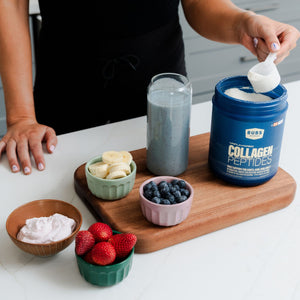
Collagen Peptides are a specific form of collagen that has been hydrolyzed. This means the long protein chains have been broken down into much smaller pieces (peptides) that are easier for your digestive system to handle. This increases their bioavailability, meaning your body can more easily transport these building blocks to where they are needed. BUBS Naturals Collagen Peptides are designed for exactly this. They are grass-fed and pasture-raised, providing a clean source of Types I and III collagen that mixes easily into your morning coffee or post-workout shake.
The Importance of Vitamin C
As mentioned, Vitamin C is a non-negotiable part of the collagen synthesis process. Even if you are taking a collagen supplement, your body needs Vitamin C to actually "turn" those amino acids into functional tissue.
If you aren't getting enough from fruits and vegetables, a supplement can fill the gap. Our Vitamin C supplement provides 500 mg with citrus bioflavonoids to support antioxidant activity and collagen formation. Keeping your Vitamin C levels stable ensures that the fibroblasts in your skin and joints have what they need to stay productive.
Healthy Lifestyle Habits
Beyond nutrition, how you treat your body matters.
-
Sleep: Most protein synthesis happens while you sleep. Deep sleep is when the body releases growth hormones that stimulate the repair of tissues and the production of new collagen.
-
Hydration: Collagen fibers need water to maintain their shape and function, and Hydrate or Die is part of the picture.
-
Exercise: Mechanical stress—like lifting weights or running—actually signals your body to produce more collagen in the bones and tendons to adapt to the load.
Bottom line: Supporting collagen production requires a holistic approach that pairs high-quality amino acid intake with essential cofactors like Vitamin C, while minimizing environmental damage from sugar, UV rays, and stress.
Collagen and Athletic Recovery
For the athlete or the weekend warrior, collagen is more than a beauty supplement. It is a recovery supplement. When you train hard, you create micro-tears in your muscles and place stress on your tendons and ligaments. Your body uses collagen to repair those connective tissues.
Many athletes report that consistent collagen intake helps with joint health and recovery speed. By providing the body with the specific building blocks it needs—namely glycine and proline—you are essentially pre-loading the system for faster repair.
Myth: Collagen is just a "beauty" supplement for skin and hair.
Fact: Collagen is a functional protein vital for joint health, bone density, and the structural integrity of tendons and ligaments, making it essential for athletic performance and recovery.
When you think about your recovery protocol, you likely think about protein for muscle repair and Creatine Monohydrate for performance, and electrolytes for hydration.
Why Quality Matters in Collagen Supplements
Not all collagen is created equal. Because collagen is derived from animals, the quality of the source matters immensely. At BUBS Naturals, we prioritize transparency and purity.
Our products are third-party tested and NSF for Sport certified. This is the gold standard for supplements, ensuring that what is on the label is exactly what is in the tub, with no banned substances or hidden fillers. For veterans, active-duty military, and competitive athletes, this level of trust is mandatory. We focus on simple, clean ingredients because we believe that real performance doesn't need a chemistry degree to understand.
Conclusion
Understanding how your body produces collagen is the first step in taking control of your physical longevity. It is a complex biological dance that requires the right raw materials, specific vitamins, and a lifestyle that protects the finished product. By focusing on high-quality protein, consistent Vitamin C intake, and protecting yourself from environmental stressors, you can help your body maintain the scaffolding that keeps you moving.
At BUBS Naturals, our mission is rooted in the legacy of Glen "BUB" Doherty, a Navy SEAL who lived a life of adventure and purpose. We carry that spirit into every product we make. That is why we donate 10% of all our profits to veteran-focused charities, following our 10% Rule. When you support your own wellness with our supplements, you are also supporting a larger mission of giving back to those who have served.
Take the next step in your wellness journey by ensuring your body has the clean, high-quality fuel it needs to build, repair, and thrive.
FAQ
Can I get enough collagen from my diet alone?
While you can get the amino acids needed for collagen from protein-rich foods like meat, fish, and eggs, the specific concentration of glycine and proline found in connective tissues is often lower in modern diets. Many people find that supplementing with collagen peptides and their benefits provides a more concentrated and convenient source of these specific building blocks.
How long does it take for the body to produce new collagen?
Collagen synthesis is a relatively slow process compared to other types of protein repair. While your body is constantly producing it, most people notice the benefits of supported production in their skin after 4 to 8 weeks, while joint and tendon improvements may take 3 to 6 months of consistent nutritional support.
Does taking collagen supplements actually work?
Yes, when you consume hydrolyzed collagen peptides, your body breaks them down into amino acids and smaller peptide chains. These are absorbed into the bloodstream and act as both the raw materials and the chemical signals that tell your fibroblasts to increase their own collagen production.
What is the best time of day to support collagen production?
There is no "perfect" time, but many people prefer taking collagen in the morning to start their day or post-workout to support the recovery of tendons and ligaments. The most important factor is consistency, as your body needs a steady supply of amino acids and cofactors like Vitamin C for collagen synthesis to maintain the production cycle.