Table of Contents
- Introduction
- What is Collagen and How Does it Relate to Muscle?
- The Amino Acid Profile: Collagen vs. Other Proteins
- Does Collagen Help Build Muscle?
- Collagen for Muscle Recovery and Repair
- How to Use Collagen in Your Fitness Routine
- Quality Matters: What to Look For
- Collagen and Weight Management
- Realistic Expectations
- Summary of Benefits for the Active Individual
- Conclusion
- FAQ
Introduction
You’ve likely seen collagen praised for its ability to smooth wrinkles or strengthen hair and nails. If you spend any time in the gym or on the trail, you might wonder if this protein does more than just support your appearance. When you’re pushing your physical limits, every supplement in your cabinet needs to earn its keep. The question of whether collagen is good for muscle isn't just about size; it's about the structural integrity of your entire body.
At BUBS Naturals, we focus on supplements that serve a functional purpose for an active lifestyle, and Collagen Peptides is one of our cleanest examples. Collagen is the most abundant protein in the human body, acting as the "glue" that holds everything together. While it differs significantly from traditional muscle-building proteins like whey, its role in your physical performance is undeniable. This guide explores how collagen interacts with muscle tissue, its impact on recovery, and where it fits into your nutritional routine.
We will break down the science of amino acids, the difference between muscle fibers and connective tissue, and how to use collagen to support your long-term fitness goals. Whether you are a veteran athlete or someone looking to stay mobile as you age, understanding the relationship between collagen and muscle is key to a more resilient body. For a broader look at that foundation, see Whole Body Collagen.
Quick Answer: While collagen is not the primary driver of muscle hypertrophy (growth) like whey protein, it is essential for the connective tissues that support and protect your muscles. It may support muscle recovery and strength by strengthening the tendons, ligaments, and fascia that allow your muscles to function efficiently.
What is Collagen and How Does it Relate to Muscle?
To understand if collagen is good for muscle, you first need to understand what it is. Collagen is a structural protein. Unlike "functional" proteins like enzymes or "contractile" proteins found in muscle fibers, collagen provides the framework. It makes up about 30% of the total protein in your body. It is the primary component of your skin, bones, tendons, ligaments, and the extracellular matrix within your muscles.
There are at least 28 known types of collagen, but three types do most of the heavy lifting. Type I is found almost everywhere, especially in tendons and bones. Type II is mainly in cartilage. Type III is specifically prevalent in muscles, arteries, and internal organs. When we talk about muscle health, Type III collagen is often the star of the show because it provides the elasticity and structure within the muscle walls. For more on how collagen production works, check out Understanding the Science of How the Body Produces Collagen.
Your body naturally produces collagen by combining amino acids from the protein you eat. However, this production begins to slow down as early as your mid-20s. By the time you reach 40 or 50, the decline becomes more noticeable, often manifesting as stiffer joints or longer recovery times after a workout. This is why many active adults look toward supplementation to fill the gap.
The Anatomy of a Muscle
When you think of a muscle, you probably think of the "meat" or the fibers that contract to move your limbs. However, a muscle is a complex system of layers. Every muscle fiber is wrapped in a thin layer of connective tissue called the endomysium. Groups of fibers are wrapped in the perimysium, and the entire muscle is encased in the epimysium.
These layers are made largely of collagen. They act as a transmission system. When your muscle fibers contract, that force is pulled through these collagen layers, into the tendons, and finally to the bone to create movement. If the "glue" (collagen) in this system is weak, the force transmission is less efficient. Supporting these layers is one of the primary reasons collagen is considered beneficial for overall muscle function.
The Amino Acid Profile: Collagen vs. Other Proteins
The reason people debate if collagen is good for muscle usually comes down to its amino acid profile. Proteins are made of amino acids, which are the building blocks of life. There are twenty amino acids in total, nine of which are "essential," meaning your body cannot make them on its own—you must get them from food.
Traditional muscle-building proteins, like whey or beef, are "complete" proteins. They contain high levels of Branched-Chain Amino Acids (BCAAs), specifically leucine. Leucine is the primary trigger for Muscle Protein Synthesis (MPS), the process where your body repairs and grows new muscle tissue.
Collagen is different. It is not a complete protein because it lacks the essential amino acid tryptophan and is very low in leucine. Instead, collagen is packed with three specific amino acids:
-
Glycine: Makes up about one-third of collagen. It supports metabolic functions and is a precursor to Creatine Monohydrate.
-
Proline: Essential for the stability of the collagen triple helix structure.
-
Hydroxyproline: A unique amino acid that helps keep collagen stable under heat and physical stress.
Why the Difference Matters
If your sole goal is to trigger the fastest possible muscle growth (hypertrophy) after a heavy lifting session, whey protein or a steak is superior to collagen. The high leucine content in those sources signals the body to build new muscle fibers.
However, if your goal is the health of the entire musculoskeletal system, collagen offers something those other proteins don't. You can think of it like this: whey protein builds the "engine" (the muscle), while collagen builds the "chassis" (the tendons, ligaments, and connective tissue). A powerful engine is useless if the chassis can't handle the torque.
Key Takeaway: Collagen should not be your only protein source for muscle growth because it lacks high levels of leucine. However, its high concentration of glycine and proline makes it uniquely suited for repairing the structural tissues that support those muscles.
Does Collagen Help Build Muscle?
The direct answer is that collagen is not the most effective protein for building large amounts of new muscle fiber. This has been demonstrated in various clinical settings. For example, some studies comparing whey protein to collagen peptides for muscle hypertrophy found that whey protein led to significantly more muscle growth over a 10-week period of resistance training.
That said, "building muscle" is often used as a catch-all term for improving body composition. Research has shown that collagen may support an increase in fat-free mass (lean mass) in specific populations.
Collagen and Sarcopenia
One area where collagen shows significant promise is in older adults. Sarcopenia is the natural loss of muscle mass and strength that occurs with aging. A study involving elderly men with sarcopenia found that combining collagen peptide supplementation with resistance training led to a higher increase in muscle mass and strength compared to a placebo group.
While the collagen likely didn't build more muscle fiber than a complete protein would have, it helped the participants stay consistent and protected their joints, which allowed them to train more effectively. For older individuals, the "lean mass" gains seen in studies might be a combination of some muscle fiber growth and a significant increase in the density of connective tissues. If you want a deeper look at recovery support, read Unlock Faster Muscle Recovery with BUBS Naturals Collagen Peptides.
Lean Mass vs. Contractile Muscle
It is important to distinguish between lean mass and contractile muscle. Lean mass includes everything in your body that isn't fat: water, bone, organs, and connective tissue. Because collagen supports the density of bones and the thickness of tendons, it can show up as an increase in "lean mass" on a body scan. This doesn't necessarily mean your biceps are getting bigger, but it does mean your body's structural foundation is becoming more robust.
Myth: Collagen is a waste of money for athletes because it's an "incomplete" protein.
Fact: While incomplete for muscle fiber growth, collagen provides the specific building blocks for the connective tissues that prevent injury and improve force transmission.
Collagen for Muscle Recovery and Repair
Recovery is where collagen truly shines for the active individual. When you train hard, you aren't just micro-tearing your muscle fibers; you are also putting immense stress on your tendons and ligaments. These tissues are made almost entirely of collagen.
Unlike muscles, which have a rich blood supply and repair relatively quickly, tendons and ligaments have very little blood flow. This is why a muscle strain might heal in a week, while a tendon injury can linger for months. Supplementing with collagen may help provide the specific amino acids your body needs to repair these "slow-to-heal" tissues. For another angle on this, see How Collagen Can Support Your Joints and Recovery This Spring.
Reducing Exercise-Induced Aches
Many athletes report that taking collagen regularly helps reduce the "nagging" pains often associated with high-volume training. This isn't necessarily because collagen is a painkiller, but because it helps maintain the integrity of the cartilage and the connective tissue within the muscle.
When the connective tissue (fascia) around the muscle is healthy and hydrated, the muscle can glide more easily. This can lead to less stiffness and a better range of motion. If you’ve ever felt "tight" despite stretching, the issue might be the quality of your collagen-based connective tissues rather than the muscles themselves.
Supporting Tendon and Ligament Health
Strong muscles are only as good as the tendons that attach them to your bones. Tendon injuries, such as Achilles tendonitis or "patellar tracking" issues, are common in sports involving running, jumping, or heavy lifting. Studies have suggested that taking collagen peptides before exercise may increase the rate of collagen synthesis in these tissues, potentially making them more resilient to the stresses of training.
How to Use Collagen in Your Fitness Routine
If you decide that collagen is a good fit for your goals, how you take it matters. You can't just toss it in a shake and expect instant results. Consistency and timing play a role in how your body utilizes these amino acids.
Optimal Dosing
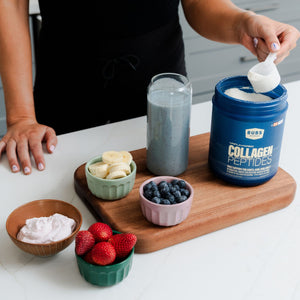
Most research suggests a dose of 10 to 20 grams of collagen peptides per day. This is the amount found in one to two scoops of our Collagen Peptides. Because collagen is easy to digest and doesn't usually cause bloating, it is easy to incorporate into your daily habits.
The Importance of Vitamin C
Your body cannot effectively synthesize collagen without Vitamin C. It acts as a co-factor, essentially "turning on" the enzymes that link amino acids together to form collagen fibers. Many people find success by taking their collagen with a source of Vitamin C, such as a glass of orange juice, or by using a dedicated supplement like our Vitamin C capsules.
Timing for Performance
There is a specific strategy for timing collagen if your goal is tendon and ligament health. Some research suggests that taking collagen about 30 to 60 minutes before your workout may be most effective.
The theory is that as you exercise, blood flow increases to your connective tissues. By having the amino acids from collagen already in your bloodstream, your body can "pump" those nutrients into the tendons and joints you are currently training. This is a different approach than whey protein, which is typically taken post-workout to support muscle fiber repair.
| Feature |
Whey Protein |
Collagen Peptides |
| Primary Goal |
Muscle Hypertrophy (Size) |
Structural Integrity (Joints/Connective Tissue) |
| Main Amino Acids |
Leucine, Isoleucine, Valine |
Glycine, Proline, Hydroxyproline |
| Best Timing |
Post-workout |
Pre-workout or anytime daily |
| Source |
Dairy (Milk) |
Bovine, Marine, or Porcine |
| Digestion |
Fast to Medium |
Very Fast (Hydrolyzed) |
Quality Matters: What to Look For
Not all collagen is created equal. If you are using it to support an active lifestyle, you need to ensure you are getting a clean, bioavailable product.
-
Hydrolyzed Peptides: Whole collagen molecules are too big for your body to absorb efficiently. Look for "hydrolyzed" collagen, which has been broken down into smaller peptides. This makes it highly bioavailable, meaning your gut can absorb it and send it to your tissues quickly.
-
Clean Sourcing: Since collagen comes from animals, the health of those animals matters. We use grass-fed and pasture-raised bovine collagen to ensure a clean final product.
-
Third-Party Testing: Especially for athletes and military personnel, knowing exactly what is in your supplement is vital. Our Collagen Peptides are NSF for Sport certified, meaning they are tested for over 280 banned substances and contaminants. For a closer look at the benefits and standards, visit Collagen Protein Benefits.
-
No Fillers: Many brands add artificial flavors, sweeteners, or "flow agents" to their powders. These are unnecessary. A high-quality collagen should be a single ingredient: hydrolyzed collagen.
Our BUBS Naturals Collagen Peptides are designed to dissolve effortlessly in any liquid. Because they are unflavored, you can mix them into your morning coffee, a pre-workout drink, or even a glass of water without changing the taste.
Collagen and Weight Management
While the primary focus is often on muscle and joints, collagen may play a minor role in weight management, which indirectly affects muscle definition. Protein is the most satiating macronutrient, meaning it helps you feel full for longer.
Some people find that adding collagen to their morning coffee helps them avoid mid-morning snacking. While it won't replace a balanced meal, it provides a clean source of protein that supports your daily totals without adding sugar or unhealthy fats. Keeping your body fat in a healthy range makes the muscle you do have more visible and reduces the load on your joints during high-impact activities.
Realistic Expectations
It is important to maintain a grounded perspective on what collagen can and cannot do. Taking collagen will not suddenly give you "3D" shoulders or a record-breaking deadlift. It is a "long game" supplement.
Most people notice the benefits of collagen after 4 to 8 weeks of consistent use. The first signs are often less clicking in the joints, faster-growing nails, or a slightly "fresher" feeling in the muscles after a hard training block. It is about building a foundation that allows you to train harder, more often, and for more years.
Note: If you are currently dealing with a significant muscle tear or joint injury, collagen should be part of a broader recovery plan overseen by a healthcare professional. It is a tool for support, not a replacement for medical treatment or physical therapy.
Summary of Benefits for the Active Individual
To wrap up the question of whether collagen is good for muscle, we can look at it through the lens of overall performance:
-
Support for the Connective Framework: It strengthens the endomysium and perimysium, the layers that hold your muscle fibers together.
-
Enhanced Force Transmission: Stronger tendons mean the power your muscles generate is more efficiently transferred to your bones.
-
Reduced Injury Risk: By supporting the health of ligaments and cartilage, collagen can help you avoid the "wear and tear" injuries that sideline many athletes.
-
Improved Recovery: It provides the specific building blocks (glycine and proline) needed to repair tissues that other proteins may lack.
-
Satiety and Lean Mass: It supports body composition goals by contributing to your total protein intake and supporting bone density.
Bottom line: Collagen is an essential support system for your muscles; while it won't make them "huge" on its own, it ensures the entire system is strong enough to perform at its peak and recover for the next challenge.
Conclusion
Is collagen good for muscle? Yes, but not in the way a traditional "protein powder" is. It doesn't replace the need for complete proteins like whey or whole food sources, but it serves a unique and critical role. By focusing on the structural health of your tendons, ligaments, and the connective tissues within the muscles themselves, collagen helps you build a body that is as durable as it is strong.
At BUBS Naturals, we believe in keeping things simple and effective. Our Collagen Peptides provide the clean, science-backed support you need to keep moving, whether you’re hitting the gym, the trail, or just keeping up with a busy life. Learn more about our story, rooted in the legacy of Glen "BUB" Doherty—living a life of adventure, purpose, and peak performance. That’s why we give back 10% of all our profits to veteran-focused charities, ensuring that your wellness journey also serves a greater cause.
If you’re ready to shore up your body’s foundation, try adding a scoop of collagen to your daily routine. It’s a small habit that pays dividends in how you feel and perform over the long haul.
FAQ
Can I use collagen as my only post-workout protein?
While collagen is beneficial, it is not recommended as your sole post-workout protein source for muscle growth. It lacks sufficient leucine and other essential amino acids required to maximize muscle protein synthesis. For best results, use collagen for joint and connective tissue support, and rely on a complete protein like whey or a plant-based blend for muscle repair.
What is the best time of day to take collagen for muscle benefits?
If you are focused on joint and tendon health, some evidence suggests taking collagen 30 to 60 minutes before you exercise. This allows the amino acids to be in your bloodstream when blood flow to your connective tissues is at its peak. However, for general health and recovery, consistency is more important than timing; taking it at the same time every day is perfectly effective.
Does collagen help with muscle soreness (DOMS)?
Collagen may help reduce the overall feeling of stiffness and "nagging" pain after exercise, but it is not a direct cure for Delayed Onset Muscle Soreness (DOMS). DOMS is primarily caused by micro-trauma to the muscle fibers. While collagen supports the connective tissue surrounding those fibers, a combination of Hydrate or Die electrolytes, complete protein, and rest is still the best approach for traditional muscle soreness.
Is bovine collagen or marine collagen better for muscles?
Both bovine and marine collagen can support muscle and connective tissue, as both contain the key amino acids glycine, proline, and hydroxyproline. Bovine collagen is often preferred for its high concentration of Type I and Type III collagen, the latter of which is especially prevalent in muscle and organ tissues. Marine collagen is also effective but is typically more focused on Type I, making it a popular choice for skin and hair.