Table of Contents
- Introduction
- The Role of Fruit in Collagen Production
- The Top Collagen-Boosting Fruits
- The Science of Collagen Synthesis
- How to Optimize Your Fruit Intake for Collagen
- Why Diet Alone Sometimes Isn't Enough
- Lifestyle Habits That Protect Your Collagen
- Practical Ways to Use This Information
- Conclusion
- FAQ
Introduction
As we cross the threshold of our mid-20s, our body’s internal production of collagen begins to downshift. You might notice it in the way your joints feel after a long run, or in the subtle changes in your skin’s elasticity. Collagen is the most abundant protein in the human body, acting as the structural "glue" that holds everything from your ligaments to your skin layers together. While animal products like bone broth are direct sources of this protein, certain fruits play a massive role in helping your body synthesize and protect its own supply.
At BUBS Naturals, we focus on providing clean, science-backed nutrition that fuels an adventurous lifestyle. Understanding which fruits are good for collagen is a vital step in maintaining your physical resilience and recovery. In this guide, we will break down the specific fruits that support collagen synthesis, explain the science of how these nutrients work, and show you how to integrate them into your daily routine. By the end of this article, you will have a clear blueprint for using whole foods to keep your structural health at its peak.
Quick Answer: The best fruits for collagen are those high in Vitamin C, such as oranges, strawberries, kiwis, and guavas. These fruits provide the essential cofactors your body needs to convert amino acids into strong collagen fibers while offering antioxidants that protect your existing collagen from environmental damage.
The Role of Fruit in Collagen Production
It is a common misconception that eating fruit provides your body with actual collagen. Collagen is an animal-derived protein; plants do not contain it. However, your body is a collagen-making machine, and that machine requires specific fuel to operate. Without the right vitamins and minerals, your body cannot effectively assemble the amino acids—glycine, proline, and hydroxyproline—into the triple-helix structure of a collagen molecule.
The most critical of these fuels is Vitamin C. This vitamin acts as the "mortar" between the "bricks" of amino acids. From a biological perspective, Vitamin C is a necessary cofactor for the enzymes prolyl hydroxylase and lysyl hydroxylase. These enzymes stabilize the collagen molecule. Without sufficient Vitamin C intake, collagen production grinds to a halt, which is why historical conditions like scurvy led to skin sores and tooth loss—your body literally began to fall apart at the structural level.
Beyond synthesis, fruits provide antioxidants. Every day, environmental stressors like UV radiation and pollution create free radicals. These are unstable molecules that break down your existing collagen fibers. The phytonutrients found in colorful fruits neutralize these free radicals, acting as a defensive shield for your skin and joints.
The Top Collagen-Boosting Fruits
When looking for which fruits are good for collagen, you should prioritize those that offer high concentrations of Vitamin C, Vitamin A, and specific minerals like zinc or copper.
Citrus Fruits: The Vitamin C Heavyweights
Citrus fruits are often the first thing people think of for Vitamin C, and for good reason. Oranges, grapefruits, lemons, and limes are dense with this nutrient. One medium orange can provide nearly 80% of your daily recommended value of Vitamin C.
These fruits are particularly effective because they contain bioflavonoids. Bioflavonoids are plant compounds that may help improve the bioavailability of Vitamin C. Bioavailability refers to how well your body can absorb and use a nutrient once you consume it. Adding a squeeze of lemon to your water or eating a grapefruit in the morning provides a steady stream of the cofactors needed for pro-collagen, the precursor to actual collagen.
Berries: Protection and Synthesis
Strawberries, blueberries, raspberries, and blackberries are powerhouses for structural health. While they are excellent sources of Vitamin C, their real strength lies in their antioxidant profile.
Berries are rich in anthocyanins. These are the pigments that give berries their deep blue, red, and purple colors. Anthocyanins serve a dual purpose: they protect the skin from oxidative stress and help stabilize the collagen matrix. When you finish a high-intensity workout, your body deals with internal inflammation. The antioxidants in berries can help manage this stress, supporting the recovery of your connective tissues.
Tropical Fruits: The Hidden Gems
If you are looking for even higher concentrations of Vitamin C than citrus can provide, look toward the tropics.
-
Guava: This fruit is often overlooked but is one of the richest sources of Vitamin C on the planet. A single guava can contain over 200mg of Vitamin C—nearly four times the amount found in an orange. It also contains small amounts of zinc, which is another cofactor for collagen production.
-
Kiwi: One kiwi contains more Vitamin C than an orange of the same size. Kiwis are also a source of copper, a mineral that helps in the formation of collagen and elastin.
-
Pineapple: Pineapple contains bromelain. This is an enzyme that helps your body break down proteins and may support a healthy inflammatory response. While bromelain doesn't build collagen directly, it helps maintain the environment where collagen can thrive.
-
Mango and Papaya: These are high in Vitamin A, which supports skin cell turnover and repair.
Tomatoes and Avocados
While often treated as vegetables, tomatoes and avocados are botanically fruits and are essential for your collagen strategy.
Tomatoes are famous for lycopene. Lycopene is a powerful antioxidant that has been shown to protect the skin from UV-induced damage. Since sun exposure is the number one cause of collagen breakdown (a process called photoaging), eating tomatoes is like providing your skin with internal protection.
Avocados contribute Vitamin E and healthy monounsaturated fats. Vitamin E works alongside Vitamin C to protect cell membranes. It helps prevent the breakdown of collagen by fighting oxidative stress. The healthy fats in avocados also ensure that your skin stays hydrated and plump, which complements the structural support provided by collagen.
Key Takeaway: Fruits do not contain collagen themselves, but they provide the essential cofactors (Vitamin C) and defenders (antioxidants) that allow your body to build and maintain its own structural integrity.
The Science of Collagen Synthesis
To understand why these fruits are so important, we have to look at how the body builds protein. When you consume protein—whether from a steak or Collagen Peptides—your digestive system breaks it down into individual amino acids. These amino acids enter the bloodstream and are sent to the "construction sites" in your body, like your skin cells (fibroblasts) or your cartilage cells (chondrocytes).
Once at the site, the cells begin to reassemble these amino acids into collagen. This is a complex process. The cells create a single strand, then two more, and then twist them together into a triple helix. Think of it like braiding hair; the tighter and more stable the braid, the stronger the final product. For a deeper look, see our guide to whole body collagen.
Vitamin C is the key to this braiding process. It allows the amino acids to "stick" together. Without it, the strands are weak and can unravel easily. This is why a diet high in fruit is non-negotiable for anyone serious about their fitness and longevity. You can have all the amino acid "bricks" in the world, but if you don't have the Vitamin C "mortar," your house won't stand.
Myth: You can get all the collagen you need just by eating fruit.
Fact: Fruit provides the cofactors, but you still need the raw building blocks (amino acids) found in high-quality protein sources or collagen supplements to actually build the tissue.
How to Optimize Your Fruit Intake for Collagen
Consistency is more important than quantity. Your body cannot store Vitamin C for long periods because it is water-soluble. This means you need a consistent daily intake rather than one giant dose on the weekend. If you want an easy way to stay on schedule, the Collagen Club can help.
Combine Fruits with Protein
To maximize collagen production, you should pair your collagen-boosting fruits with a high-quality protein source. This ensures that you have both the building blocks and the construction tools available at the same time.
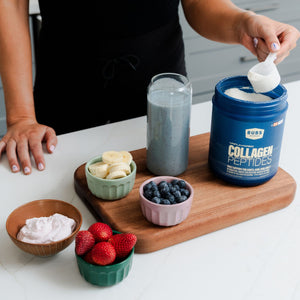
For example, a morning smoothie is an excellent vehicle for this. We recommend mixing a scoop of our Collagen Peptides—which are grass-fed, pasture-raised, and hydrolyzed for easy mixing—with a cup of berries and a squeeze of lime. The peptides provide the specific amino acids your body needs, while the fruit provides the Vitamin C to put them to work.
Watch the Sugar
While fruits are healthy, some are very high in sugar. High blood sugar can lead to a process called glycation. Glycation happens when sugar molecules attach to your collagen fibers, making them brittle and prone to breaking. This is why we suggest focusing on lower-glycemic fruits like berries and citrus most of the time, saving higher-sugar fruits like mango or pineapple for post-workout recovery when your body can better handle the glucose.
Raw vs. Cooked
Vitamin C is heat-sensitive. If you cook your fruits or drink highly processed, pasteurized juices, you lose a significant amount of the collagen-boosting potential. Whenever possible, eat your fruit raw or lightly blended. Freshly squeezed lemon juice added to room-temperature water is far more effective than a lemon-flavored tea that has been boiled.
Bottom line: To support collagen effectively, aim for 2–3 servings of raw, Vitamin C-rich fruit daily, ideally paired with a clean protein source to provide the necessary amino acids for tissue repair.
Why Diet Alone Sometimes Isn't Enough
While eating the right fruits is essential, it isn't always enough to overcome the natural decline of aging or the demands of an active lifestyle. As we age, our digestive efficiency can decrease, and our body’s ability to synthesize protein becomes less streamlined.
This is where supplementation fills the gap. Our Collagen Peptides are third-party tested and NSF for Sport certified, ensuring you get the cleanest product possible without any fillers. By supplementing with 10–20 grams of collagen daily, you provide your body with a concentrated dose of the specific amino acids (glycine, proline, and hydroxyproline) that are rare in standard diets. When you combine this with the Vitamin C from fruits, you are giving your body every advantage it needs to maintain joint health and skin elasticity.
Lifestyle Habits That Protect Your Collagen
Nutrition is only one side of the coin. You also need to protect the collagen you already have. Even the best diet can't keep up if you are constantly destroying your structural proteins through lifestyle choices.
Sun Protection
UV rays are the primary enemy of collagen. They trigger the production of enzymes called matrix metalloproteinases (MMPs) which specifically target and break down collagen fibers. While the lycopene in tomatoes helps, it isn't a substitute for shade and sunscreen.
Hydration
Collagen is a hydrated protein. It needs water to maintain its shape and flexibility. This is particularly true in your joints, where the cartilage is mostly water held in place by a collagen framework. If you are dehydrated, your joints will feel stiffer, regardless of how much fruit you eat. We developed our Hydrate or Die electrolytes to support this exact need—providing the minerals necessary to pull water into your cells where it can support your tissues.
Sleep and Stress
Collagen synthesis peaks while you sleep. This is when your body enters its "repair and replace" mode. Chronic stress, on the other hand, releases cortisol. High levels of cortisol can actually degrade collagen and slow down the production of new fibers. Prioritizing seven to nine hours of quality sleep is just as important as your nutrition plan.
| Fruit Category |
Key Nutrient |
Collagen Role |
Best Examples |
| Citrus |
Vitamin C |
Essential cofactor for synthesis |
Oranges, Lemons, Grapefruit |
| Berries |
Anthocyanins |
Protects collagen from oxidation |
Strawberries, Blueberries |
| Tropical |
Copper/Zinc |
Supports structural formation |
Kiwi, Guava, Papaya |
| Stone Fruits |
Vitamin A |
Supports skin cell repair |
Peaches, Apricots |
| Savory Fruits |
Lycopene |
Protects against UV damage |
Tomatoes, Red Peppers |
Practical Ways to Use This Information
Knowing which fruits are good for collagen is only useful if you act on it. Here is a simple daily protocol to support your structural health:
-
The Morning Boost: Start your day with a glass of water and the juice of half a lemon. This "wakes up" your collagen synthesis pathways.
-
The Recovery Smoothie: After a workout, blend a scoop of BUBS Naturals Collagen Peptides with one cup of frozen berries and a half-cup of Greek yogurt. This provides the amino acids, the Vitamin C, and the protein needed for recovery.
-
The Mid-Day Snack: Keep a kiwi or a handful of strawberries nearby. These provide a low-calorie, high-nutrient way to bridge the gap between meals while keeping your antioxidant levels high.
-
The Evening Defense: Include tomatoes or bell peppers with your dinner. The lycopene and Vitamin C will help protect your skin while you sleep.
Conclusion
Supporting your body's collagen isn't about finding a "miracle" fruit; it’s about understanding the synergy between whole-food nutrients and clean supplementation. By focusing on fruits high in Vitamin C and antioxidants—like citrus, berries, and tropical varieties—you provide the essential tools your body needs to build and protect its structural foundation.
At BUBS Naturals, we are committed to helping you live a life of adventure and purpose. Our products are designed to complement a healthy, active lifestyle, providing the clean ingredients you need to feel your best. We also believe that wellness should have a bigger mission. That is why we donate 10% Rule to veteran-focused charities in honor of Glen "BUB" Doherty. Every scoop of collagen you take not only supports your own health but also contributes to a greater cause.
Start by adding one of these collagen-supporting fruits to your next meal. Whether it’s a squeeze of lime in your water or a bowl of fresh berries, these small, consistent actions will pay dividends for your joints and skin over time. Stay active, stay nourished, and keep moving forward.
FAQ
Does eating fruit actually provide collagen to the body?
No, fruits do not contain collagen themselves as it is an animal-based protein. However, fruits provide essential nutrients like Vitamin C and various antioxidants that are required for your body to produce its own collagen and protect existing fibers from damage.
Which fruit has the highest amount of Vitamin C for collagen?
While oranges are the most famous, guavas and kiwis actually contain higher concentrations of Vitamin C. A single guava can provide several times the daily recommended value, making it a powerhouse for anyone looking to support their structural health.
Can I just take a Vitamin C supplement instead of eating fruit?
While a supplement can provide the necessary Vitamin C, whole fruits offer additional benefits like fiber, minerals, and a wide array of antioxidants (like anthocyanins and lycopene) that work together to protect your collagen. Whole foods are generally the preferred way to get these nutrients due to their complex nutrient profiles.
Why do I need to eat fruit if I already take a collagen supplement?
Collagen supplements provide the amino acid "bricks," but your body needs Vitamin C to act as the "mortar" to build those bricks into functional tissue. Without sufficient Vitamin C from fruits or other sources, your body cannot efficiently use the supplemental collagen you are consuming.