Table of Contents
- Introduction
- The Foundation of Your Smile: Oral Anatomy
- How Gum Disease Destroys Collagen
- Can Supplements Help With Receding Gums?
- The Role of Type I and Type III Collagen
- Supporting Nutrients for Gum Health
- Lifestyle Factors That Impact Oral Collagen
- Incorporating Collagen Into Your Daily Routine
- The Role of Professional Care
- Why Quality Matters
- Conclusion
- FAQ
Introduction
When you think about oral health, your mind likely goes straight to teeth. You think about white enamel, avoiding cavities, and the occasional dental cleaning. However, the real foundation of a healthy smile isn't the teeth themselves—it is the tissue that holds them in place. Your gums are the unsung heroes of your mouth, and their strength depends heavily on a single structural protein: collagen.
At BUBS Naturals, we focus on supplements like our Collagen Peptides that support a life of adventure and peak physical performance. While most people look to collagen for joint mobility or skin elasticity, its role in oral health is just as critical. The integrity of your gum tissue, the ligaments that anchor your teeth, and even the bone structure of your jaw all rely on this essential protein.
This guide explores the science behind oral connective tissue and answers whether adding a collagen supplement can help maintain your gums. We will look at how your body uses these proteins to fight inflammation and protect your smile. Understanding the connection between protein intake and oral resilience is the first step toward better long-term health.
Quick Answer: Yes, collagen is excellent for your gums because they are composed of roughly 60% collagen. While it cannot "regrow" severely receded gums, clinical research suggests that collagen support can improve gum thickness, reduce inflammation, and strengthen the ligaments that keep teeth anchored.
The Foundation of Your Smile: Oral Anatomy
To understand if collagen is good for your gums, you first have to look at what gums are made of. For a broader look at Collagen Protein Benefits, it helps to start with the tissue that supports the smile. Your mouth is a complex environment where soft tissue meets hard mineral structures. Most people believe teeth are like bones, but they are actually quite different.
The outer layer of a tooth, the enamel, contains almost no collagen. It is mostly calcium and phosphate. However, as you move deeper into the tooth and the surrounding structures, collagen becomes the dominant player. The "periodontium" is the collective name for the tissues that surround and support your teeth. This includes your gums (gingiva), the periodontal ligament, and the alveolar bone.
The Gingival Tissue
Your gums are a type of connective tissue. Their job is to create a tight seal around the neck of each tooth. This seal acts as a barrier, preventing bacteria from reaching the sensitive roots and the jawbone. Approximately 60% of this gingival tissue is made of collagen fibers. These fibers provide the firmness and resilience required to withstand the mechanical stress of chewing and brushing.
The Periodontal Ligament (PDL)
Deep inside the tooth socket lies the periodontal ligament. This is a specialized connective tissue that tethers the tooth to the jawbone. It is incredibly dense with collagen, specifically Type I and Type III. The PDL acts as a shock absorber. When you bite down on something hard, the collagen fibers in the PDL stretch and compress to protect the tooth from fracturing. Without high-quality collagen, these ligaments can weaken, potentially leading to tooth mobility.
The Alveolar Bone
The jawbone that holds your tooth sockets is called the alveolar bone. Like all bone in the human body, it is not just a pile of minerals. It is a living matrix. About 90% of the organic matrix of this bone is Type I collagen. This protein provides the "flex" in the bone, while minerals provide the hardness. If the collagen matrix degrades, the bone can become brittle or lose density, which compromises the stability of your teeth.
How Gum Disease Destroys Collagen
Gum health is a constant battle against inflammation. When bacteria from food and plaque sit along the gumline, your immune system reacts. This reaction is called inflammation. While inflammation is designed to kill bacteria, chronic inflammation can accidentally turn against your own body.
During the progression of gum disease, also known as periodontitis, the body produces specific enzymes called matrix metalloproteinases (MMPs). One of the most destructive is MMP-8, which is often referred to as "collagenase." As the name suggests, this enzyme’s primary job is to break down collagen.
When you have chronic gum inflammation, these enzymes start eating away at the collagen fibers in your gums and periodontal ligaments. This leads to the "pockets" your dentist measures during checkups. As the collagen disappears, the gums lose their attachment to the tooth, the seal breaks, and the recession begins. Protecting your collagen is essentially a way of protecting your biological defense system.
Key Takeaway: Collagen is the structural "glue" of the mouth, making up the majority of your gums and the ligaments that hold teeth in place. Maintaining these collagen levels is vital because gum disease specifically targets and destroys these protein fibers through inflammatory enzymes.
Can Supplements Help With Receding Gums?
A common question is whether taking a supplement can actually regrow gums that have already receded. It is important to have realistic expectations. Gum recession is a physical migration of the tissue, and once the attachment is lost, a supplement alone usually won't make it "climb" back up the tooth.
However, supplementation is not pointless. Research suggests that providing the body with the right amino acids can improve the quality and thickness of the remaining tissue. In one study involving bovine collagen, researchers found that it could enhance gum integrity and increase the thickness of the tissue around the teeth.
Our BUBS Naturals Collagen Peptides provide a concentrated source of the amino acids proline, hydroxyproline, and glycine. These are the specific building blocks your body needs to synthesize new collagen. By supporting the internal "scaffolding" of your mouth, you are giving your gums a better chance to stay firm and resist further recession.
Bioavailability and Digestion
When you consume collagen, your body doesn't just transport the powder directly to your gums. It breaks the protein down into smaller chains called peptides. These peptides enter the bloodstream and act as signals to your "fibroblasts"—the cells responsible for creating new collagen.
This is why we use hydrolyzed collagen. Hydrolysis is a process that breaks the large protein molecules into smaller, more "bioavailable" pieces. Bioavailable simply means your body can absorb and use the nutrients more efficiently. For an active person, this means the nutrients can get to work faster, whether they are repairing a strained tendon or supporting the connective tissue in your mouth.
The Role of Type I and Type III Collagen
Not all collagen is the same. There are at least 28 different types in the human body, but Type I and Type III are the most relevant for oral health.
-
Type I Collagen: This is the strongest, most rigid type. It is found in your tendons, bones, and the periodontal ligament. It provides the tensile strength needed to keep your teeth firmly anchored during heavy use.
-
Type III Collagen: This type is more flexible and is often found in "young" tissue or tissue undergoing repair. It is a major component of the gums and the pulp inside your teeth.
Most high-quality grass-fed supplements, like those we produce, contain a blend of these two types. This combination ensures you are supporting both the rigid structures (bone and ligaments) and the more flexible, vascular tissues (gums and pulp).
Myth: Collagen supplements will instantly regrow receded gums.
Fact: While supplements can't "grow back" tissue that is completely gone, they can increase the thickness, density, and resilience of existing gum tissue, helping prevent further damage.
Supporting Nutrients for Gum Health
Collagen doesn't work in a vacuum. Your body is a complex chemical plant that requires specific tools to turn protein into functional tissue. If you are taking collagen but lack the necessary co-factors, you might not see the full benefit.
Vitamin C: The Essential Co-factor
Vitamin C is perhaps the most important partner for collagen. It acts as the "welder" that cross-links the amino acid chains to form a strong triple-helix structure. Without Vitamin C, collagen synthesis stops entirely. This is why people with scurvy (extreme Vitamin C deficiency) experience bleeding gums and tooth loss. Their bodies literally fall apart because they can no longer maintain their collagen structures.
We offer a Vitamin C supplement specifically because we know how vital it is for the collagen process. Taking them together is a smart way to ensure your body has both the raw materials and the tools to use them.
Hydration and Electrolytes
The health of your oral tissues also depends on fluid balance. Your gums are highly vascular, meaning they have a lot of blood flow. Proper hydration ensures that nutrients reach these tissues and that waste products are carried away.
For those who train hard or spend time outdoors, staying hydrated is a constant challenge. Our Hydrate or Die electrolyte formula is designed for fast hydration without added sugars. Sugar is a major enemy of gum health, so using a clean electrolyte mix helps maintain the fluid balance in your oral tissues without feeding the bacteria that cause gum disease.
Lifestyle Factors That Impact Oral Collagen
You can take all the supplements in the world, but your lifestyle choices will ultimately determine the health of your gums. Certain habits are known "collagen killers" that can undo your hard work.
The Impact of Sugar
Sugar is the primary fuel for the bacteria that trigger gum inflammation. Beyond that, sugar causes a process called "glycation." This is when sugar molecules attach to collagen fibers, making them brittle and weak. If you want to keep your gums strong, reducing refined sugar is one of the best moves you can make.
Smoking and Vaping
Smoking is devastating for oral collagen. It restricts blood flow to the gums, which starves the tissue of oxygen and nutrients. Smokers often don't even realize they have gum disease because the lack of blood flow prevents the gums from bleeding, which is the usual warning sign. Tobacco use also increases the production of those collagen-eating enzymes (MMPs) we mentioned earlier.
Stress and Sleep
Chronic stress raises cortisol levels, which can interfere with the body's ability to repair tissue. Most collagen synthesis happens while you sleep. If you aren't getting enough rest, your body doesn't have the time it needs to rebuild the "scaffolding" in your gums and joints.
Incorporating Collagen Into Your Daily Routine
Making collagen part of your day is simple and doesn't require a complete lifestyle overhaul. The key to seeing results is consistency. Connective tissue, like gums and ligaments, has a slower turnover rate than your skin. This means you need to be patient.
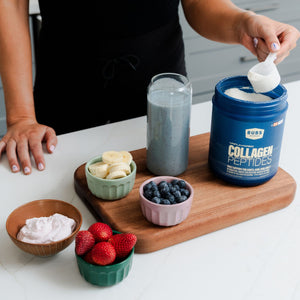
Most people find it easiest to mix their collagen into their morning coffee or a post-workout shake. Our BUBS Naturals Collagen Peptides are unflavored and dissolve easily in both hot and cold liquids. Because they are NSF for Sport certified, you can trust that there are no hidden "BS" ingredients or contaminants—just pure, grass-fed protein.
A Sample "Gum Health" Routine:
-
Morning: Mix one scoop of MCT Oil Creamer into your coffee or tea. If you like a creamy texture, it adds healthy fats that support mental clarity.
-
Afternoon: Stay hydrated with an electrolyte drink like Hydrate or Die. This keeps your mouth moist and your tissues hydrated.
-
With Meals: Ensure you are getting enough Vitamin C through whole foods or a high-quality supplement to support the collagen you took in the morning.
-
Night: Focus on quality sleep to allow the repair process to take place.
The Role of Professional Care
While nutrition and supplements are powerful tools, they are not a replacement for the dentist. Professional cleanings remove "tartar" or "calculus"—hardened plaque that you cannot brush away at home. This tartar is a constant source of inflammation that will continue to destroy collagen until it is removed.
Think of supplements as the "daily maintenance" for your vehicle and dental visits as the "professional tune-up." Both are necessary if you want your smile to last as long as you do.
Why Quality Matters
The supplement industry is often full of hype and low-quality ingredients. When you are looking for collagen to support your oral health, you should look for three things: sourcing, processing, and testing.
We source our collagen from grass-fed, pasture-raised cattle. This ensures a cleaner amino acid profile without the hormones or antibiotics often found in factory-farmed animals. We also insist on third-party testing. Being NSF for Sport certified means our products undergo rigorous checks to ensure they meet the highest standards of purity.
When you choose a clean product, you are giving your body the best possible chance to repair and maintain its tissues. This "no BS" approach is the core of everything we do.
Conclusion
Your gums are the foundation of your oral health, and collagen is the foundation of your gums. By understanding that your gingival tissue and periodontal ligaments are made primarily of protein, you can see why nutrition is so important for a healthy smile. While collagen supplements aren't a magic fix for advanced recession, they provide the essential building blocks to keep your tissues thick, resilient, and better equipped to handle the stresses of daily life and aging.
Supporting your body with clean, science-backed ingredients is an investment in your future self. At BUBS Naturals, we believe in living a life of purpose and adventure. That mission is inspired by the legacy of Glen "BUB" Doherty, and it’s why we donate 10% of all our profits to veteran-focused charities through our 10% Rule. When you take care of your health, you're also helping us support a greater cause.
Take care of your foundation, stay active, and keep your smile strong for the road ahead.
FAQ
Can collagen supplements regrow receded gums?
No, collagen supplements cannot physically grow back gum tissue that has completely receded or detached from the tooth. However, they can help improve the density and thickness of the remaining gum tissue, which may prevent further recession and improve overall oral health.
How long does it take for collagen to help my gums?
Connective tissues like gums have a slower metabolic rate than skin, so changes usually take longer to notice. Most people report seeing improvements in tissue resilience and general oral health after 8 to 12 weeks of consistent daily supplementation.
Which type of collagen is best for oral health?
Type I and Type III collagen are the most beneficial for your mouth. Type I is essential for the strength of the periodontal ligaments and jawbone, while Type III is a major component of the gingival (gum) tissue and the pulp inside the teeth.
Does Vitamin C matter for gum collagen?
Vitamin C is absolutely essential because it is a required co-factor for the enzymes that build collagen. Without adequate Vitamin C, your body cannot effectively turn the amino acids from your collagen supplement into the strong, functional tissue needed to support your teeth.
Bottom line: Collagen is a critical component of healthy gums and jawbone structure, and while it isn't a cure-all for dental issues, consistent supplementation supports the resilience and integrity of your mouth's connective tissues.