Table of Contents
- Introduction
- The Science of Creatine Solubility
- Factors That Influence How Creatine Mixes
- Does Solubility Affect Bioavailability?
- Comparing Different Forms of Creatine
- The History of Creatine in Performance
- Practical Tips for Mixing Creatine Monohydrate
- Why Quality Matters More than Solubility
- Potential Side Effects and Water Solubility
- The Bottom Line on Creatine Monohydrate
- FAQ
Introduction
If you have ever reached the bottom of your shaker bottle only to find a gritty, sand-like residue, you have likely wondered: is creatine monohydrate water soluble? It is a common frustration for athletes and fitness enthusiasts who want to ensure they are actually consuming their supplements rather than leaving them stuck to the plastic. Understanding how this compound interacts with liquid is not just about aesthetics; it is about making sure your routine is as efficient as possible.
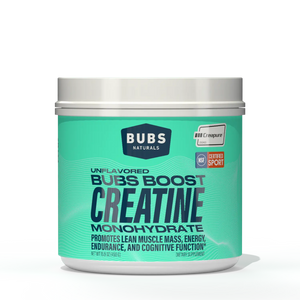
At BUBS Naturals, we prioritize transparency and education so you can get the most out of your training. Creatine is one of the most researched supplements in the world, yet its physical properties—specifically how it dissolves—still cause confusion. Many people assume that if a powder does not disappear completely into a glass of water, it must be low quality or ineffective. If you want to see the product behind the science, start with our Creatine Monohydrate or browse the full Boosts collection.
This guide will break down the science of creatine solubility, how temperature and pH levels affect your mix, and why the "grittiness" in your cup does not necessarily mean your body is missing out. If you want a deeper dive into the broader creatine category, check out our Creatine & Fitness library for more education.
Quick Answer: Creatine monohydrate is technically water soluble, but it has a relatively low solubility rate at room temperature (about 14 grams per liter). While it may not dissolve instantly or completely in cold water, its bioavailability remains nearly 99%, meaning your body absorbs it effectively regardless of whether it is fully dissolved in the glass.
The Science of Creatine Solubility
To understand why creatine behaves the way it does in your water bottle, we have to look at its chemical structure. Creatine monohydrate is a molecule where one molecule of creatine is bound to one molecule of water. This is known as a "water of crystallization."
In a laboratory setting, creatine monohydrate is described as an ampholytic amino acid. This means it can react as both an acid and a base. In its powdered form, it exists as white, odorless crystals. When you drop those crystals into water, they begin to break apart and disperse. However, compared to something like sugar or salt, creatine has a much harder time "disappearing" into the liquid.
The Saturation Point
Solubility refers to the maximum amount of a substance that can dissolve in a specific amount of solvent (like water) at a specific temperature. For creatine monohydrate, the saturation point at room temperature (around 68°F or 20°C) is roughly 14 grams per liter.
If you are following a standard serving of 5 grams, you would technically need about 350ml to 400ml (roughly 12 to 14 ounces) of water to fully dissolve it at room temperature. If you use less water or if the water is very cold, the creatine will stay in a suspended state rather than a dissolved state. This is why you see particles floating or settling at the bottom.
Dissolved vs. Suspended
There is a significant difference between a powder being dissolved and being suspended. When creatine is dissolved, the molecules are fully incorporated into the water, creating a clear solution. When it is suspended, the particles are floating in the liquid but remain in their solid, crystalline form.
Many people worry that suspended creatine is "wasted" or will not be absorbed by the body. Science suggests otherwise. Studies show that nearly 99% of orally ingested creatine monohydrate is either taken up by the muscles or excreted, regardless of whether it was perfectly clear in the glass before you drank it.
Factors That Influence How Creatine Mixes
Several variables change how easily your creatine scoop blends into your morning drink or post-workout shake. Understanding these can help you avoid the "bottom of the bottle" grit.
1. Water Temperature
Temperature is the most significant factor in creatine solubility. The relationship between temperature and how well creatine dissolves is almost linear.
-
Cold Water (4°C / 39°F): Can only dissolve about 6 grams per liter.
-
Room Temp (20°C / 68°F): Can dissolve about 14 grams per liter.
-
Warm Water (50°C / 122°F): Can dissolve about 34 grams per liter.
If you mix your creatine into ice-cold water, it will almost certainly settle at the bottom. If you mix it into a warm beverage, like coffee or tea, it will likely dissolve completely and become invisible.
2. Particle Size and Micronization
Not all creatine powders are created equal. You may have seen the term "micronized" on supplement labels. Micronization is a process where the manufacturer grinds the creatine crystals into a much finer powder—often up to 20 times smaller than standard creatine.
Our Creatine Monohydrate is a single-ingredient, high-quality formula designed to maximize this surface area. While micronization does not change the chemical solubility of the creatine, it significantly improves the "mixability." Smaller particles stay suspended in the liquid much longer, making it easier to drink the entire serving before it has a chance to sink to the bottom.
3. The pH Level of the Liquid
The acidity of your drink also plays a role. Lowering the pH of a solution (making it more acidic) can increase the solubility of creatine. This is one reason why some people prefer to mix their creatine with fruit juices like orange or grape juice. The slight acidity helps the crystals break down more readily.
Key Takeaway: While temperature and particle size affect how quickly creatine "disappears" in your glass, they do not change how much your body ultimately uses. The stomach is a highly acidic environment at a warm internal temperature, which naturally completes the dissolution process once you swallow it.
Does Solubility Affect Bioavailability?
The most important question for any athlete is: "If it doesn't dissolve in the water, is it still working?"
The answer is yes. Bioavailability refers to the proportion of a substance that enters the circulation when introduced into the body and is so able to have an active effect. Creatine monohydrate is famous in the scientific community for having incredibly high bioavailability. For a broader explanation of how creatine supports performance and wellness, see What is the Use of Creatine Supplement for Health and Performance?.
Digestion and Absorption
When you consume creatine, it travels to the stomach. Your stomach is a very warm environment (roughly 98.6°F) and contains powerful hydrochloric acid. As we noted earlier, both heat and low pH increase creatine’s solubility.
By the time the creatine reaches your small intestine, where most absorption occurs, those crystals have been broken down. From there, creatine enters the bloodstream and is transported to your muscles via a specialized sodium-dependent transporter.
The Myth of Creatine Waste
Some marketing for alternative forms of creatine, like Creatine HCL (hydrochloride) or buffered creatine, claims that because they are more soluble in water, they are better absorbed by the body.
While it is true that Creatine HCL is more soluble in a glass of water, there is no strong evidence to suggest it results in higher muscle creatine levels than standard monohydrate. Since monohydrate is already 99% absorbed, there is very little room for "improvement" in absorption. You are essentially paying more for a powder that dissolves faster in your shaker, not one that necessarily performs better in your cells.
Myth: If you can see creatine at the bottom of your shaker, your body won't absorb it.
Fact: Your stomach acid and body temperature are much more effective at dissolving creatine than a cold glass of water. As long as you consume the particles, your body will process them efficiently.
Comparing Different Forms of Creatine
Because solubility is a common pain point, the supplement industry has introduced various forms of creatine. Let’s look at how they compare to the gold standard: monohydrate.
| Form of Creatine |
Water Solubility |
Creatine Content |
Scientific Support |
| Creatine Monohydrate |
Moderate |
~88% |
Very High |
| Creatine Anhydrous |
Moderate |
100% |
High |
| Creatine HCL |
High |
~72% |
Low |
| Creatine Pyruvate |
High |
~60% |
Moderate |
| Creatine Ethyl Ester |
High |
~82% |
Low (mostly degrades to creatinine) |
As the table shows, while some forms are more soluble, they often contain less actual creatine by weight. For example, if you take 5 grams of Creatine Pyruvate, you are only getting about 3 grams of actual creatine. With monohydrate, you get the most "bang for your buck" and the backing of decades of clinical research.
The History of Creatine in Performance
To understand why we still rely on monohydrate despite its modest solubility, it helps to look at how it became the staple of sports nutrition. Creatine was first identified in 1832, but it didn't hit the mainstream until the 1992 Olympics in Barcelona.
Several gold medalists, including sprinters and hurdlers, were reported to be using creatine to support their training. This sparked a massive wave of research. Scientists wanted to know how a simple organic compound could have such a profound impact on power and recovery.
What they found was the Phosphagen System. This is the body’s quickest way to regenerate Adenosine Triphosphate (ATP)—the primary energy currency of your cells. If you want to keep exploring that performance story, Creatine for Muscle Growth: An Essential Partnership? is a helpful next read.
How the Phosphagen System Works
-
ATP Usage: When you perform a high-intensity movement (like a heavy squat or a 40-meter sprint), your muscles burn through ATP for energy.
-
ADP Creation: As ATP is used, it loses a phosphate group and becomes Adenosine Diphosphate (ADP). ADP cannot be used for energy.
-
The Recharge: This is where creatine comes in. Your body stores creatine as phosphocreatine. An enzyme called creatine kinase takes the phosphate from your stored creatine and gives it back to the ADP, turning it back into ATP.
-
The Result: You can maintain peak power for a few seconds longer, or recover slightly faster between sets.
Because this system is so fundamental to human movement, the modest solubility of monohydrate has never been a dealbreaker for elite athletes. The benefits to strength, power, and muscle mass far outweigh the minor inconvenience of having to shake your bottle one extra time.
Practical Tips for Mixing Creatine Monohydrate
If the texture of creatine bothers you, or if you want to ensure you aren't leaving half your serving in the bottle, here are the most effective ways to mix it.
Use Room Temperature or Warm Liquid
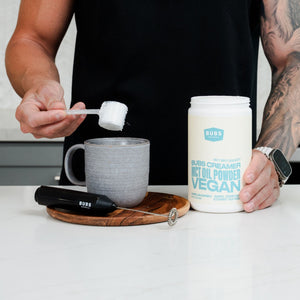
Avoid using fridge-cold water if you want the powder to dissolve. Using room temperature water makes a noticeable difference. Many people have success mixing their scoop into a morning cup of coffee or tea. The heat from the coffee will dissolve the creatine almost instantly, and because it is tasteless and odorless, it won't ruin your brew.
The "Swirl and Chug" Method
If you are using a shaker bottle, don't just shake it and let it sit. The crystals will begin to settle within seconds. The best method is to give the bottle a quick swirl right before you take a sip. This keeps the creatine suspended in the liquid so you swallow it all at once.
Combine with Carbohydrates
Research has shown that consuming creatine with carbohydrates can help increase the amount of creatine that your muscles actually take up. This happens because carbohydrates trigger an insulin spike, and insulin helps "drive" nutrients into the muscle cells.
Mixing your creatine with a bit of fruit juice or a post-workout recovery drink that contains simple sugars can serve two purposes: it slightly improves solubility due to the acidity and improves the overall effectiveness of the supplement.
Add it to a Smoothie
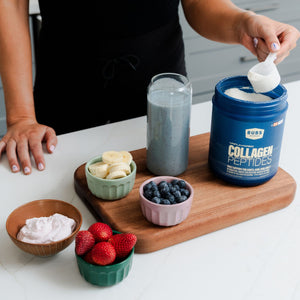
If you really hate the texture, the best solution is a blender. Adding your scoop of creatine to a protein smoothie with a banana or some berries will completely mask the texture. The thickness of the smoothie prevents the creatine from settling at the bottom, ensuring you get the full dose every time.
Why Quality Matters More than Solubility
While we have spent a lot of time discussing how creatine dissolves, the quality of the powder is actually a much bigger concern. Because creatine is a high-volume supplement produced globally, purity can vary between brands.
At BUBS Naturals, we believe in keeping things simple and clean. We choose the monohydrate form because it is the most stable and most studied. We also ensure our products are third-party tested and NSF for Sport certified. This certification is critical for athletes and military personnel who need to be certain that what is on the label is exactly what is in the jar—nothing more, nothing less. For a closer look at our standards, read What is Creatine Supplement Made From? Inside the Purity and Process, and learn more in Our Story.
When a powder is "no BS," it means we don't add fillers or flow agents that might interfere with how the product works. You get 100% pure creatine monohydrate that is designed to support your strength and recovery goals.
Potential Side Effects and Water Solubility
A common misconception is that because creatine "holds water," it causes bloating or dehydration. People often link this to its solubility, thinking that undissolved creatine sits in the gut and pulls water toward it.
While it is true that creatine causes "water retention," this water is primarily stored inside the muscle cells (intracellular hydration), not under the skin or in the digestive tract. This is actually a positive thing—it makes your muscles look fuller and helps with cellular signaling.
If you do experience minor stomach discomfort, it is usually because you are taking a very large dose (like during a 20-gram loading phase) on an empty stomach with too little water. Increasing the amount of water you drink when taking creatine can resolve most issues. You can also see how this fits into the bigger picture of the BUBS mission and giving back.
The Bottom Line on Creatine Monohydrate
Is creatine monohydrate water soluble? Yes, but it has its limits. It prefers warm environments and plenty of liquid to fully dissolve. However, the most important takeaway is that complete dissolution in your glass is not required for the supplement to work.
Your body is an expert at processing creatine. Whether you mix it into a warm coffee or swirl it into a cold shaker bottle, the result is the same: higher muscle creatine stores, better ATP regeneration, and improved performance in the gym or on the trail.
At BUBS Naturals, we are driven by more than just fitness; we are driven by a legacy of service and adventure. Our mission is inspired by the life of Glen "BUB" Doherty, and we honor his memory by creating products that help you live a fuller, more active life. We also donate 10% of all profits to veteran-focused charities, so every scoop you take helps support a larger cause.
Ready to add a clean, effective tool to your routine? Focus on consistency, stay hydrated, and don't sweat the grit at the bottom of the cup.
-
Prioritize consistency: Take your 5g every single day, regardless of your training schedule.
-
Use enough liquid: Aim for at least 8-12 ounces of water or your favorite beverage per scoop.
-
Don't overcomplicate it: Monohydrate is the king of creatine for a reason. Stick with the science.
FAQ
Does creatine monohydrate expire if it gets wet?
Once creatine monohydrate is mixed with water, it eventually begins to break down into a waste product called creatinine, which has no performance benefits. However, this process is slow and typically takes several hours or even days. As long as you drink your mixture within an hour or two of mixing it, the creatine will remain stable and effective.
Can I mix creatine in hot coffee?
Yes, you can absolutely mix creatine into hot coffee. The heat will actually help the creatine dissolve much more quickly and completely than cold water. Research shows that the heat of a standard hot beverage is not high enough to degrade the creatine molecule, so you will still get the full performance benefits.
Is it better to take creatine on an empty stomach?
Creatine can be taken on an empty stomach, but many people find it easier to tolerate when taken with food or a protein shake. Taking it with a source of carbohydrates or protein may also slightly improve its uptake into the muscles due to the insulin response. If you have a sensitive stomach, try taking it after a meal.
Why does my creatine look like sand?
If your creatine looks like sand or settles at the bottom of your glass, it is simply because the solution has reached its saturation point or the water is too cold. This is a natural physical property of creatine monohydrate and does not indicate that the product is bad or "fake." Using a micronized powder and warmer liquid can help minimize this effect.