Table of Contents
- Introduction
- What is Collagen and Why Does It Matter?
- At What Age Does Skin Lose Collagen?
- Factors That Accelerate Collagen Loss
- The Concept of Collagen Banking
- Signs Your Body is Losing Collagen
- How to Support and Boost Collagen Production
- The Role of BUBS Naturals in Your Routine
- Conclusion
- FAQ
Introduction
You might notice it first in the mirror or during a morning run. Maybe it is the fine lines around your eyes that no longer disappear when you stop smiling. Perhaps it is a slight loss of firmness in your skin or a new stiffness in your joints after a long hike. These changes are often the first visible signals that your body’s internal scaffolding is shifting. That scaffolding is collagen, the most abundant protein in your body.
At BUBS Naturals, we believe that understanding your biology is the first step toward mastering your performance and longevity. Collagen Peptides fit naturally into that mindset. Collagen acts as the glue that holds your skin, muscles, and bones together. While it is a natural part of the human experience to see these levels dip over time, knowing exactly when and why this happens gives you the edge. You can take proactive steps to support your body’s structural integrity long before the effects become significant.
This guide explores the specific age when collagen production begins to drop. For a deeper look at the supplement itself, read All About Collagen Peptides. We will break down the biological process of collagen loss and identify the environmental factors that speed up the clock. Most importantly, we will cover the practical, science-backed ways you can support your skin and joint health at any age. Our goal is to help you stay capable, resilient, and ready for whatever adventure comes next.
What is Collagen and Why Does It Matter?
Collagen is not just a buzzword in the beauty industry. It is a critical structural protein that makes up roughly 30% of the total protein in your body. Think of it as the literal "scaffolding" for your tissues. It provides the strength and elasticity required for your skin to bounce back, your joints to move smoothly, and your bones to remain dense.
In your skin, collagen lives primarily in the dermis, which is the middle layer. It works alongside another protein called elastin. While elastin allows your skin to stretch, collagen provides the firmness that keeps it from sagging. Without enough collagen, the skin becomes thinner and less resilient.
Beyond the surface, collagen is vital for your physical performance. It is a major component of your tendons and ligaments. These are the tissues that connect your muscles to your bones and your bones to each other. When collagen production is high, these connective tissues are supple and strong. When it drops, you might feel more "brittle" or notice that recovery takes longer after a heavy training session.
The Science of the Triple Helix
At a molecular level, collagen is made of amino acids—mostly glycine, proline, and hydroxyproline. These amino acids link together to form long chains. These chains then twist around each other to create a "triple helix" structure. This unique shape is what gives collagen its incredible tensile strength.
Your body naturally synthesizes this protein by combining the amino acids you get from food with specific cofactors like Vitamin C, zinc, and copper. For a broader look at the nutrient itself, read All About Vitamin C. If you are missing any of these building blocks, your body cannot produce high-quality collagen effectively. This is why nutrition is so closely linked to how your skin and joints age.
At What Age Does Skin Lose Collagen?
The timeline for collagen loss is more predictable than most people realize. While you might feel invincible in your early 20s, your biological "peak" for collagen production usually occurs during this decade.
The Mid-20s: The Starting Line
For most people, natural collagen production begins to decline around age 25. On average, you start losing about 1% of your total collagen every year after this point. In your mid-20s, you likely won't see any changes. Your "collagen bank" is still full, and your body is still efficient at repairing damage. However, this is the stage where the slow, steady depletion begins.
The 30s: First Visible Signs
By the time you reach your 30s, the cumulative effect of losing 1% per year starts to show. You might notice "expression lines"—the faint wrinkles that appear when you laugh or squint—beginning to linger. The skin may appear slightly less "plump" than it did five years prior. This is also when many athletes notice that their joints feel a bit more taxed after high-impact activities.
The 40s: The Rapid Decline
In your 40s, collagen production drops more significantly. The structural support in the dermis weakens, leading to more pronounced wrinkles and a noticeable loss of skin elasticity. At this stage, your body is also less efficient at producing the oils that keep your skin hydrated. This combination of less collagen and less moisture can make the skin look duller and more fragile.
The 50s and Menopause: A Unique Shift
For women, the most dramatic shift in collagen levels occurs during the first few years of menopause. Research suggests that women can lose up to 30% of their skin’s collagen in just the first five years after the onset of menopause. This is due to the sharp decline in estrogen, a hormone that directly supports collagen synthesis. This period often results in a rapid change in skin thickness and a softening of the jawline.
Key Takeaway: Collagen loss is a slow burn that starts in your mid-20s. By age 40, the decline accelerates, and for women, menopause marks the most significant biological drop in collagen levels.
Factors That Accelerate Collagen Loss
While age is the primary driver, your lifestyle and environment act as accelerators. Some people "age" faster than others because their collagen is being damaged or degraded by external stressors. Understanding these factors allows you to protect the collagen you still have.
UV Exposure and Photoaging
Sun exposure is the number one cause of premature skin aging. Ultraviolet (UV) rays penetrate deep into the dermis and break down collagen fibers. This process is called photoaging. When UV light hits the skin, it also triggers the production of free radicals—unstable molecules that further damage the protein structures. Over time, this leads to deep wrinkles, leathery texture, and "sun spots."
Chronic Inflammation and Sugar
A diet high in refined sugars and processed carbohydrates can lead to a process called glycation. This happens when sugar molecules in your bloodstream attach to proteins like collagen. This creates harmful new molecules called advanced glycation end products (AGEs). Glycation makes your collagen fibers stiff and brittle, meaning they break easily rather than stretching. This is why chronic inflammation from a poor diet is so detrimental to skin health.
Smoking and Blood Flow
Smoking is particularly destructive to collagen. Nicotine constricts the blood vessels in the outermost layers of your skin. This impairs blood flow and prevents oxygen and essential nutrients—like Vitamin C—from reaching the cells that produce collagen. Furthermore, the chemicals in tobacco smoke directly damage the collagen and elastin fibers, leading to the "smoker’s lines" often seen around the mouth.
Stress and Cortisol
High levels of the stress hormone cortisol can actually break down collagen. When you are under chronic stress, your body’s ability to repair itself is compromised. This can manifest as "stress-worn" skin that looks tired and loses its bounce. Prioritizing recovery and sleep is not just good for your brain; it is essential for your structural health.
The Concept of Collagen Banking
A growing trend in wellness and dermatology is "collagen banking." The idea is simple: start supporting your collagen levels in your 20s and early 30s while your body is still in its peak production phase. By doing this, you are essentially "depositing" more collagen into your system to mitigate the inevitable decline that comes later.
Think of it like a retirement fund for your skin and joints. You aren't trying to reverse aging when you are 60; you are building a strong foundation while you are young so that the aging process is much more gradual. This involves a combination of high-quality nutrition, smart supplementation, and rigorous sun protection.
Signs Your Body is Losing Collagen
How do you know if your levels are dropping? Since you cannot take a simple blood test to measure your "collagen score," you have to look for the physical indicators.
-
Skin Texture Changes: Your skin might look "crepey" or thin, like tissue paper. This is a sign that the dermis is losing its density.
-
Hollowing Around the Eyes: As collagen and fat levels drop, the area under the eyes and around the temples can appear sunken or hollow.
-
Joint Discomfort: Collagen makes up the cartilage that cushions your joints. If you feel a "grinding" sensation or persistent stiffness, it may be due to thinning cartilage.
-
Brittle Hair and Nails: Collagen contains the amino acids needed to build keratin, the protein that makes up your hair and nails. A deficiency can lead to slow growth or frequent breakage.
-
Digestive Issues: The lining of your digestive tract is made of connective tissue that relies on collagen. Some people find that as they age, their gut becomes more sensitive, which can sometimes be linked to a weakening of this intestinal barrier.
Myth: Collagen creams can replace the collagen lost in the deep layers of your skin.
Fact: Collagen molecules in creams are usually too large to penetrate the skin barrier and reach the dermis. While these creams can be great for surface hydration, you need internal support—like diet and supplements—to impact the actual structure of your skin.
How to Support and Boost Collagen Production
The good news is that your body never stops producing collagen entirely. You can stimulate production and protect your existing stores by giving your body the right tools.
Prioritize Targeted Nutrition
Your body needs "raw materials" to build the triple helix. This means eating enough protein. Focus on foods high in the amino acids glycine and proline.
-
Bone Broth: One of the few direct food sources of collagen.
-
Lean Meats and Fish: Provide the complete protein profile required for synthesis.
-
Vitamin C Sources: Vitamin C is non-negotiable. Without Vitamin C, your body cannot physically link the amino acids together to form collagen.
-
Zinc and Copper: Found in nuts, seeds, and shellfish, these minerals act as catalysts for collagen production.
Utilize Hydrolyzed Collagen Peptides
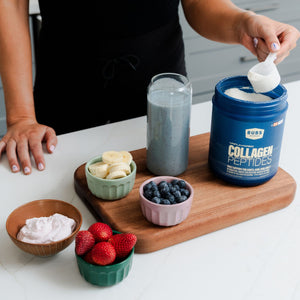
Standard protein can be difficult for the body to break down and direct specifically toward collagen synthesis. This is where supplementation becomes valuable. Our Collagen Peptides are hydrolyzed, which means the protein has been broken down into smaller, shorter chains of amino acids called peptides.
This process makes the collagen highly "bioavailable." In plain English, your body can absorb it quickly and use it more efficiently. Because our formula is single-ingredient and pasture-raised, it mixes effortlessly into your morning coffee or post-workout shake without changing the flavor. It is a simple way to ensure your body has a steady supply of the building blocks it needs every single day.
Strength Training and Movement
Resistance training is not just for building muscle. Stressing your bones and connective tissues through weight-bearing exercise stimulates the cells called fibroblasts. These are the cells responsible for producing collagen. By staying active, you are signaling to your body that it needs to keep your tendons and ligaments strong and resilient.
Protecting the Barrier
External protection is just as important as internal support.
-
Wear SPF 30+ Daily: Even on cloudy days, UV rays are actively breaking down your collagen.
-
Prioritize Sleep: Your body does the bulk of its protein synthesis and cellular repair while you sleep.
-
Hydrate: Hydrate or Die helps support hydration when your body needs it most.
The Role of BUBS Naturals in Your Routine
We believe that your supplements should be as clean and hardworking as you are. Our approach to collagen is rooted in the idea that "no BS" leads to better results. We don't add fillers, artificial sweeteners, or unnecessary flavors to our products. If you want to explore more clean performance support, browse our Boosts collection.
When you use our Collagen Peptides, you are getting Type I and Type III collagen. These are the specific types that support your skin, hair, nails, and joints. We have seen athletes use it to support their recovery after grueling mountain sessions, and we have seen wellness enthusiasts use it to maintain that healthy, resilient glow as they age.
We also offer a simple Vitamin C supplement because we know how critical that antioxidant is for the collagen synthesis process. By combining clean nutrition with high-quality supplementation, you are taking control of your aging process rather than just letting it happen to you.
Conclusion
Losing collagen is an inevitable part of growing older, but it does not have to mean a loss of vitality. While production starts its slow decline in your mid-20s, the choices you make in your 30s, 40s, and beyond determine how well your body holds up. By focusing on sun protection, a nutrient-dense diet, and high-quality supplementation, you can support your body’s structural integrity for years to come.
At BUBS Naturals, we are driven by more than just wellness. Learn more in The BUBS Story. We were founded to honor the legacy of Glen "BUB" Doherty, a Navy SEAL who lived a life of adventure and purpose. In his honor, we donate 10% of all our profits to veteran-focused charities. When you choose our products, you aren't just investing in your own health—you are helping us give back to the community that serves us all.
Bottom line: You cannot stop the clock, but you can definitely slow it down. Start supporting your collagen today to keep your skin resilient and your body ready for the next challenge.
FAQ
Is it too late to start taking collagen if I am over 50?
It is never too late to support your body's protein needs. While the most dramatic decline happens around menopause for women, providing your body with hydrolyzed collagen peptides can still help support skin hydration, joint comfort, and muscle maintenance in your 50s, 60s, and beyond.
Can men benefit from collagen as much as women?
Yes, men experience a steady decline in collagen production starting in their 20s as well. While men do not go through a rapid drop like menopause, they often experience the effects of collagen loss through joint stiffness and reduced skin elasticity. Many male athletes use collagen to support their tendons and ligaments during heavy training phases.
How long does it take to see results from collagen supplements?
Results vary from person to person, but most studies suggest that it takes about 4 to 12 weeks of consistent daily use to notice changes. You might first notice improvements in nail strength or skin hydration, while joint support and a reduction in fine lines typically take a bit longer to become apparent.
Does dietary collagen like bone broth work the same as supplements?
Bone broth is a fantastic whole-food source of collagen, but it can be difficult to know exactly how much collagen you are getting in each serving. Supplements like our Collagen Peptides offer a concentrated, measured dose of hydrolyzed collagen that is specifically designed for high absorption and convenience in a daily routine.